
Aziz said Pakistan is committed not to transfer nuclear weapons to other states or assist others to acquire nuclear weapons and consistently supported the goal of a nuclear-weapons-free world.

Discussions covered a wide range of issues, including global nuclear non-proliferation challenges.
Voicing "serious concern" over India's nuclear liability law, the United States on Friday said New Delhi could seek International Atomic Energy Agency's help in evaluating its legislation's compliance with the Convention on Supplemental Compensation.
India was on Wednesday unperturbed by Nuclear Suppliers Group's decision to strengthen guidelines on enrichment and reprocessing technology transfer, saying it expected its bilateral agreements on full implementation of nuclear deals to be fully honoured without any pre-conditions.
Hours after Pakistan Prime Minister Yousuf Raza Gilani said that his country "qualifies" for a civilian nuclear deal with the US, like that of India, the Obama Administration in a blunt message told it that such a deal is not on platter of its talks with Islamabad.

India, Pakistan, Israel and South Sudan were the four UN member states which have not signed the NPT, the international pact aimed at preventing the spread of nuclear weapons.

Ignoring all previous protests and opposition to the deal, the saffron party has changed its stance, without providing any explanation. What has changed? Accountability and explanations on this U-turn will be welcomed.

'And if the United States, at that time, perceives India to have welched on the deal, not been our friend, when we did so much to make it a friend, that's trouble.'
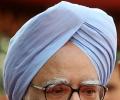
Ahead of Prime Minister Manmohan Singh's visit to the United States, a controversy has broken out over the nuclear liability law with reports suggesting that an agreement will be signed which may not be in tune with the law.
Minister of State for External Affairs Inderjit Singh said China, in response to a query, has reiterated its position on complete prohibition and thorough destruction of nuclear weapons.
"India's defence and strategic affairs have to be decided on the basis of continuity and national consensus with due deliberations. These are issues best kept above partisan politics," the PM said.
Appreciating India's track record on the non-proliferation front, Japan on Friday expressed keenness to conclude the civil nuclear agreement with it at the earliest, but made it clear that such cooperation would be suspended if New Delhi conducted an atomic test.With one round of negotiations on nuclear cooperation already having been concluded, External Affairs Minister S M Krishna and his Japanese counterpart Katsuya Okada discussed the issue.

It is time the political leaderships in this country arrived at a common ground over issues of foreign and security policy concerns. There has to be a greater communication between the government and the Opposition leaderships for the nation to present a unified face against the rest of the world, advises N Sathiya Moorthy.

The interim budget 2024-25 on Thursday allocated Rs 202868.70 crore to the Ministry of Home Affairs (MHA) with the highest share of funds going to the paramilitary forces like Central Reserve Police Force (CRPF), Border Security Force (BSF) and Central Industrial Secular Force (CISF), showing priority on internal security and border guarding.
The Pakistan government has no plans to roll back the country's atomic programme and is committed to maintaining a minimum nuclear deterrence, Parliamentary Affairs Minister Babar Awan said Tuesday. The Pakistan People's Party-led government will not compromise on the country's defence and sovereignty, he said in the National Assembly or lower house of Parliament.

Weeks after 'breakthrough', substantial work is yet to be done

Attending the Nuclear Security Summit for the first time, Modi is expected to lay out his vision of securing nuclear weapons.

The old Parliament building will now be known as 'Samvidhan Sadan', Lok Sabha Speaker Om Birla said on Tuesday as the functioning of Parliament shifted to its new building in New Delhi.
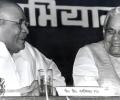
'He told senior journalists a few days after the Babri Masjid demolition, 'Jo hua theek hua. Maine isliye hone diya ki BJP ki rajniti hamesha ke liye khatam ho jaye.'

Presiding over the third Atal Bihari Vajpayee memorial lecture that was delivered by former Singaporean diplomat Bilahari Kausikan in New Delhi, Jaishankar also hailed Vajpayee's stint as an external affairs minister, and his role in strengthening India's ties with the United States and Russia.
'We welcome the investigations the Pakistani government is conducting,' said state department spokesman Richard Boucher.
Part of the focus of the current discussions is also on the "next steps" that are involved in the civilian nuclear initiative such as status of India's negotiations with the International Atomic Energy Agency on India-specific safeguards and the NSG
Leading South Asia experts have assured the United States Congress that the prospect of Pakistan's nuclear arsenal falling into fundamentalist hands is, at least in the short term, unlikely.
Menon clarified that there were no conditions attached with the deal.
A top Bush Administration official has expressed hope that the civil nuclear deal with India will be done and that the Americans, in about twenty years, would be able to look at India as being one of its two or three most important partners.

The meeting of the foreign ministers of the P5+1 nations aimed to smoothen out major bumps in reaching a nuclear deal with Iran has ended with a positive note.
Samajwadi Party general secretary Amar Singh, who was instrumental in his party's volte-face on supporting the United Progressive Alliance government and the India-United States nuclear deal, recently visited the United States to meet with the presidential hopeful Hillary Clinton who he says is a good friend. In this interview, he speaks about the nuclear deal and the post-poll scenario

20 years ago this day, May 11, 1998, India conducted its second nuclear test at Pokharan in Rajasthan. In a fascinating interview on Rediff.com, K Subrahmanyam revealed how Indian PMs reacted to nuclear ambitions.

The two countries also signed three other agreements -- to enhance aviation links, to jointly work in the area of energy efficiency and promotion of parliamentary cooperation.
Rejecting some critics' argument as to what message the US was sending to Iran by signing a nuclear energy deal with India, Burns said, "We don't see the connection between what Iran is doing and what India seeks to do."

Rulers in New Delhi and their political aides in sensitive states like Tamil Nadu have to be doubly careful not to provoke a situation whose consequences may be much more than visible now to the naked eye, notes N Sathiya Moorthy.
The Iranian nuclear issue, which threatens to snowball into a major issue, is also likely to figure at the two-day talks.
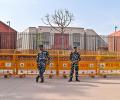
Both the new and the old Parliament complex and their allied buildings will be brought under a comprehensive security cover of the CISF which will also have the existing elements of Parliament Security Service (PSS), the Delhi Police and the Parliament Duty Group (PDG) of the CRPF, the sources said.
India and Japan have agreed to restart talks on a bilateral nuclear cooperation agreement aimed at allowing Japanese companies to export atomic power technology and equipment to India.
The Indian government of India has requested for the postponement because, as a result of the recent transition in leadership, an external affairs minister has not yet taken office.

Modi held talks with Abe after arriving in the Laotian capital to attend the Association of Southeast Asian Nations-India and the East Asia summits that will take place on Thursday.
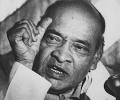
'If Rao had, in fact, given a word to President Clinton in 1994 that India would not test, he would not have encouraged Vajpayee to test. The note, said to have been handed over to Vajpayee by Rao with the words, 'Now is the time to accomplish my unfinished task' may not have been a reference to nuclear tests at all,' says T P Sreenivasan.

The Indian position on the Russia-Ukraine war and the unconditional treaty between China and Russia appear to have caused some ripples in India-US relations and led to a reappraisal of India's usefulness to the US in the eventuality of a conflict with China, notes Ambassador T P Sreenivasan.

Kissinger's approach of balance of power, secret diplomacy and moderating ideology are the need of the hour. That is the greatest tribute to an intellectual who had a major impact on the world in his lifetime, notes Colonel Anil A Athale.

Informing the world leaders of measures taken by him, Modi said India will continue to accord a high national priority to nuclear security through strong institutional framework, independent regulatory agency and trained and specialised manpower.
